Last week’s economic data offered an encouraging picture of where the Trump era will be starting from.
November 21, 2016
Last week’s economic data offered an encouraging picture of where the Trump era will be starting from.
November 18, 2016
I usually begin thinking about my economic forecast for the next year around the third quarter. At that point, the current year is largely on the books, and we know enough to start looking ahead a bit.
November 17, 2016
Since the election, much of the financial commentary has centered on the stock market's surprising surge. In fact, though, the largest changes by far have been in expectations for interest rates, which, in turn, have affected the bond markets.
November 16, 2016
Brad here. Back in August, Peter Essele, a lead portfolio manager at Commonwealth, wrote a very timely piece on the risks involved with low-volatility strategies. When we were talking the other day, he suggested writing a follow-up on that—and given what has happened since his original post, I agreed it was a great idea.
November 15, 2016
As I mentioned last week, Donald Trump’s administration could have a number of positive effects on the U.S. economy. With government spending growth set to ramp up—and taxes and regulations set to be cut—you can almost see a potential boom forming. It could be a good couple of years to come.
November 14, 2016
Last week’s big economic and market news was the election. What might it tell us about the future? Let’s take a closer look.
November 11, 2016
As predicted, the world did not end upon Donald Trump’s election to the presidency. In fact, from an economic and market perspective, it has appeared to be good news, at least so far. Of course, it’s still early days, and the question now is, What happens next?
November 10, 2016
Although many were predicting a significant pullback on Mr. Trump’s election, we, in fact, got a fairly significant advance. What’s up with that? I suspect there are several reasons.
We woke up this morning to a new era.
For the past several years, the United States has had either a Democrat-controlled government or a divided government. As a result of yesterday’s vote, Republicans will soon control the presidency, the Senate, and the House.
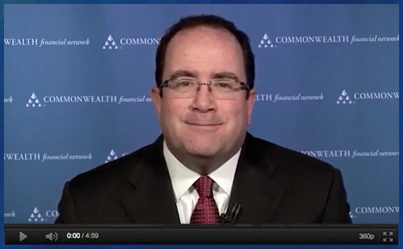
This morning, I was on CNBC’s Worldwide Exchange discussing deregulation and offering thoughts on market volatility in the wake of the presidential election.
Episode 16
February 11, 2026
Episode 15
January 15, 2026
Episode 14
December 17, 2025
Episode 13
November 19, 2025
Episode 12
October 14, 2025
The information on this website is intended for informational/educational purposes only and should not be construed as investment advice, a solicitation, or a recommendation to buy or sell any security or investment product. Please contact your financial professional for more information specific to your situation.
Certain sections of this commentary contain forward-looking statements that are based on our reasonable expectations, estimates, projections, and assumptions. Forward-looking statements are not guarantees of future performance and involve certain risks and uncertainties, which are difficult to predict. Past performance is not indicative of future results. Diversification does not assure a profit or protect against loss in declining markets.
The S&P 500 Index is a broad-based measurement of changes in stock market conditions based on the average performance of 500 widely held common stocks. All indices are unmanaged and investors cannot invest directly in an index.
The MSCI EAFE (Europe, Australia, Far East) Index is a free float‐adjusted market capitalization index that is designed to measure the equity market performance of developed markets, excluding the U.S. and Canada. The MSCI EAFE Index consists of 21 developed market country indices.
The Dow Jones Industrial Average is computed by summing the prices of the stocks of 30 large companies and then dividing that total by an adjusted value, one which has been adjusted over the years to account for the effects of stock splits on the prices of the 30 companies. Dividends are reinvested to reflect the actual performance of the underlying securities.
The Russell 2000 is a market-capitalization weighted index, with dividends reinvested, that consists of the 2,000 smallest companies within the Russell 3000 Index. It is often used to track the performance of U.S. small market capitalization stocks.
One basis point (bp) is equal to 1/100th of 1 percent, or 0.01 percent.
The VIX (CBOE Volatility Index) measures the market’s expectation of 30-day volatility across a wide range of S&P 500 options.
The forward price-to-earnings (P/E) ratio divides the current share price of the index by its estimated future earnings.
Third-party links are provided to you as a courtesy. We make no representation as to the completeness or accuracy of information provided on these websites. Information on such sites, including third-party links contained within, should not be construed as an endorsement or adoption by Commonwealth of any kind. You should consult with a financial advisor regarding your specific situation.
Member FINRA, SIPC
Please review our Terms of Use.
Commonwealth Financial Network®