The Independent Market Observer

Fed Set to Cut Rates for the First Time Since 2008: Hooray?

July 30, 2019

There has been a great deal of coverage about the expected rate cut by the FOMC at its regular meeting this week. Markets are counting on a cut of 25 bps (one-quarter percentage point), which has pretty much been confirmed by the Fed. There is even some betting that the cut will be twice as much. In any case, this move has been widely cheered as a necessary precaution—an “insurance cut” in the jargon—to prevent an economic slowdown from turning into something worse. If we step back and look at the big picture, though, there is less to cheer about.

Continue reading → Leave a comment

Monday Update: Latest Economic Reports Better Than Expected

July 29, 2019

Last week saw a number of important economic updates, covering housing sales, business orders, and second-quarter growth. Much of the news came in better than expected, with mixed housing sales serving as the only fly in the ointment. This will be a very busy week for updates, as we finish off July and head into August.

Continue reading → Leave a comment

Economy Continues to Confound the Doubters

July 26, 2019

With this morning’s report on economic growth, we see that the economy has beaten expectations once again. Markets anticipated growth would drop from 3.1 percent in the first quarter to 1.8 percent for the second quarter. Instead, the first estimate is for growth of 2.1 percent. That number doesn’t sound like a major difference, but it’s actually a big deal. Let’s take a look at why.

Continue reading → Leave a comment

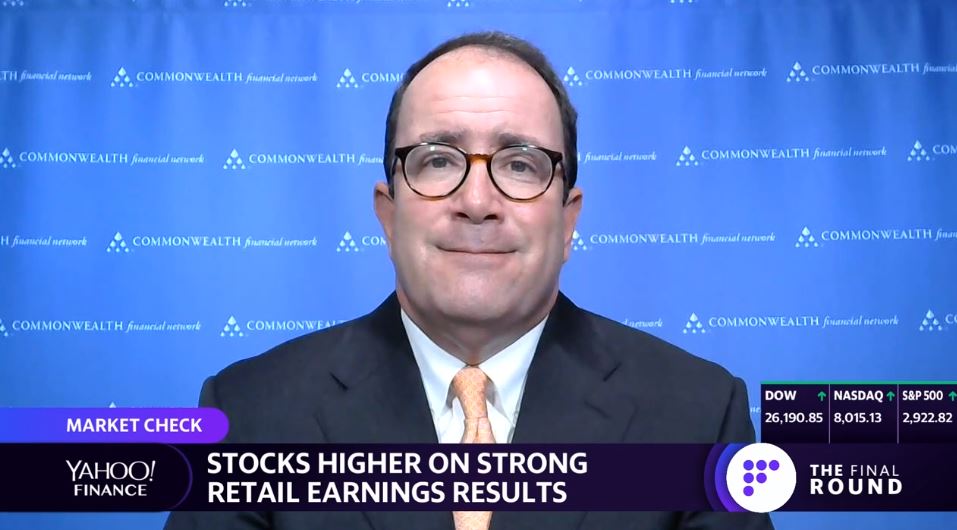
Appearance on CNBC’s Power Lunch, July 25, 2019 [Video]

July 25, 2019

The European Central Bank has signaled for a possible change in monetary policy. What could this mean for the markets and investors? I discussed the risks and more today on CNBC’s Power Lunch.

Continue reading → Leave a comment

Will Boris Johnson Get Brexit Right?

July 25, 2019

Today, I’d like to continue the discussion of yesterday’s post on the need to understand what is happening elsewhere in the world. So, let’s take a contrarian look at Brexit and the recent elevation of Boris Johnson to the head of the British government.

Continue reading → Leave a comment

The West and the Middle World: A Review of Destiny Disrupted, by Tamim Ansary

July 24, 2019

For quite a while, the U.S. was focused on other parts of the world. Wars in the Middle East, the Greek crisis, and North Korea all made headlines and were front of mind for many investors. Recently, though, that view has largely faded. We are still at war in Afghanistan, but no one seems to be talking about. A hard Brexit is looming, same thing. Attention has returned to what is happening here in the U.S.

Continue reading → Leave a comment

Deal on Spending and Debt Ceiling Is Good News for Economy

July 23, 2019

This morning’s announcement of the deal between Congress and the White House to suspend the debt ceiling for the next two years is undiluted good news. With an agreement that the government can borrow to spend the money that it has already committed to spending, we can avoid a totally unnecessary, politically driven crisis that could have caused real economic damage. Assuming the deal actually gets passed and signed, it would remove the only near-term roadblock to continued expansion here in the U.S. Like I said, this is definitely good news.

Continue reading → Leave a comment

Monday Update: Retail Sales, Consumer Confidence Highlight Busy Week

July 22, 2019

Last week was packed with economic updates that covered a wide portion of the economy. For the most part, the news came in better than expected, with increases in consumer confidence and spending highlighting the data. This will be a quieter week, with a focus on housing and the first report of second-quarter GDP growth.

Continue reading → Leave a comment

What Earnings Recession?

July 19, 2019

The term recession is having a moment. There is talk of a manufacturing recession, an earnings recession, and, the big one, an economic recession here in the U.S. Worry has been rising with the headlines of slower growth, especially with the recent inversion of the yield curve. Recession is a bad, bad word.

Continue reading → Leave a comment

Are We Seeing Signs of Peak Growth?

July 18, 2019

In retrospect, a good candidate for demonstrating the peak of the boom may be yesterday’s announcement by Netflix that subscriber growth came in well below expectations during the second quarter: the number of subscribers was up by 2.7 million against expectations of 5.3 million. Worse, in its most developed market (i.e., the U.S.), subscriber numbers were actually down by 126,000, against an expected gain of 310,000. This marks the first time the company has ever seen a decline in U.S. subscribers.

Continue reading → Leave a comment

Subscribe via Email

AI_Community_Podcast_Thumb - 1


Episode 14
December 17, 2025

Episode 13
November 19, 2025

Episode 12
October 14, 2025

Episode 11
September 10, 2025

Episode 10
August 13, 2025

More


Hot Topics


New Call-to-action

Archives

see all

Subscribe


Disclosure

The information on this website is intended for informational/educational purposes only and should not be construed as investment advice, a solicitation, or a recommendation to buy or sell any security or investment product. Please contact your financial professional for more information specific to your situation.

Certain sections of this commentary contain forward-looking statements that are based on our reasonable expectations, estimates, projections, and assumptions. Forward-looking statements are not guarantees of future performance and involve certain risks and uncertainties, which are difficult to predict. Past performance is not indicative of future results. Diversification does not assure a profit or protect against loss in declining markets.

The S&P 500 Index is a broad-based measurement of changes in stock market conditions based on the average performance of 500 widely held common stocks. All indices are unmanaged and investors cannot invest directly in an index.

The MSCI EAFE (Europe, Australia, Far East) Index is a free float‐adjusted market capitalization index that is designed to measure the equity market performance of developed markets, excluding the U.S. and Canada. The MSCI EAFE Index consists of 21 developed market country indices.

One basis point (bp) is equal to 1/100th of 1 percent, or 0.01 percent.

The VIX (CBOE Volatility Index) measures the market’s expectation of 30-day volatility across a wide range of S&P 500 options.

The forward price-to-earnings (P/E) ratio divides the current share price of the index by its estimated future earnings.

Third-party links are provided to you as a courtesy. We make no representation as to the completeness or accuracy of information provided on these websites. Information on such sites, including third-party links contained within, should not be construed as an endorsement or adoption by Commonwealth of any kind. You should consult with a financial advisor regarding your specific situation.

Member FINRASIPC

Please review our Terms of Use

Commonwealth Financial Network®