Brad here. Today we’ll get an update on the municipal bond market from Nick Follett, manager of fixed income on our Investment Management and Research team. Over to you, Nick.



August 21, 2020
Brad here. Today we’ll get an update on the municipal bond market from Nick Follett, manager of fixed income on our Investment Management and Research team. Over to you, Nick.

August 20, 2020
Brad here. With so much unknown in our world, it seemed the perfect time to discuss how to position a portfolio for uncertainty. Today, Christ Stuart, a senior investment research analyst on our Investment Management and Research team, will do just that. Take it away, Chris.

August 19, 2020
Brad here. Today's post on the growing disparity we're seeing between growth and value stocks is brought to you by Peter Roberto, an investment research analyst on Commonwealth’s Investment Management and Research team. Take it away, Peter.

August 18, 2020
Brad here. Today’s post on the recent volatility of the U.S. dollar comes from Anu Gaggar, senior analyst on the Investment Management and Research team here at Commonwealth. Take it away, Anu.
Not too long ago, Brad wrote that the dollar is not going away. While that may be true, we are seeing considerable volatility in its value. What’s going on—and what does it mean for your investments? Of course, there is no crystal ball to answer such questions, but we can certainly take a deeper dive to better understand what is happening and how to deal with it.

August 17, 2020
Last week was relatively busy on the economic update front, with a focus on inflation, retail sales, and consumer confidence. The reports came in mixed, with better-than-expected results for consumer confidence and jobless claims offsetting disappointing retail sales data and faster-than-anticipated inflation in July. This week will be relatively quiet for economic updates, with releases focusing on the housing sector and the minutes from the Fed’s most recent meeting.
August 14, 2020
Today, I'd like to provide an update on the coronavirus, including the effects on the economy and markets. We had some good news on the pandemic front this week, with the virus now back under control. Nationally, the daily spread rate is down to around 1 percent per day, and the daily number of new cases has held steady at about 55,000. Plus, the data shows that outbreaks are being contained in most states. One area of concern is testing. The number of tests has trended down over the past two weeks, and the positive rate remains well above what it should be.

August 14, 2020
My colleague Sam Millette, senior investment research analyst on Commonwealth’s Investment Management and Research team, has helped me put together this month’s Market Risk Update. Thanks for the assist, Sam!
Markets continued to rise in July, showing the second wave of the pandemic was not enough to derail the economic recovery. The S&P 500 increased by a strong 5.64 percent during the month. The Nasdaq Composite and Dow Jones Industrial Average (DJIA) also saw positive performances, marking a solid start to the third quarter. Although the continued market rebound in July was certainly welcome for investors, very real risks to markets remain, as we can see when we look at the key factors that matter when determining the overall risk level.

August 13, 2020
The good news is that the second wave of infections looks to have peaked and turned back down in the past two weeks. Case growth is down significantly from the peak, and the case growth rate has ticked back down to the lows seen in mid-June. Two weeks ago, we discussed the peak of the second wave, and this decline is the next step. The data indicates that, in most states, outbreaks are being contained.
August 13, 2020
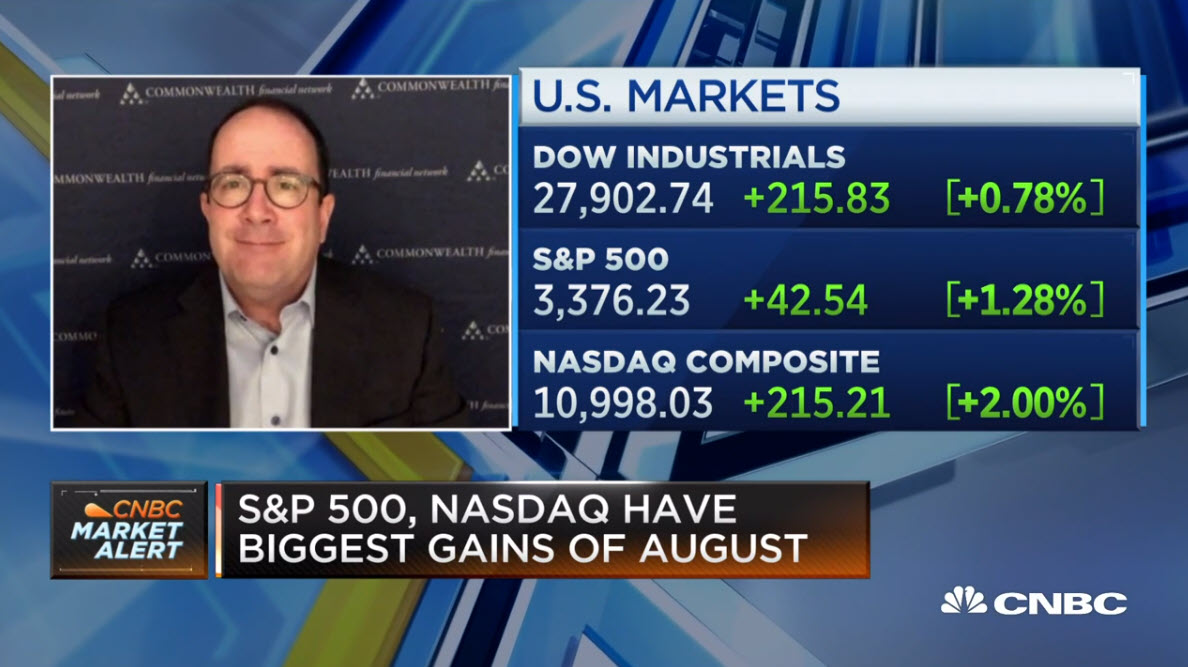
Yesterday I appeared on CNBC’s The Exchange to discuss the sectors I favor right now and the markets.

August 12, 2020
My colleague Sam Millette, senior investment research analyst on Commonwealth’s Investment Management and Research team, has helped me put together this month’s Economic Risk Factor Update. Thanks for the assist, Sam!