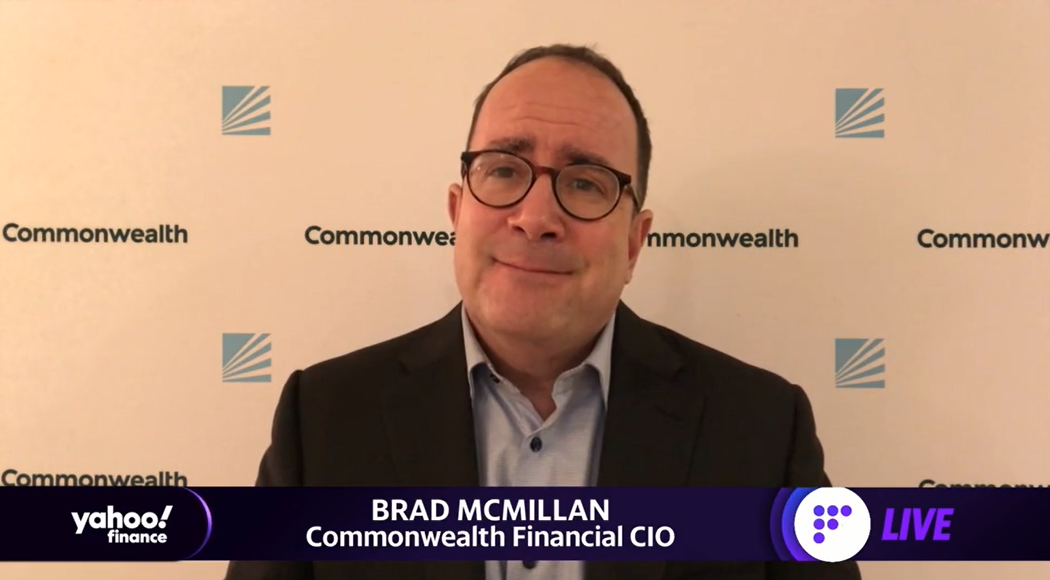
Yesterday I appeared on Yahoo Finance’s Live to discuss the current market and outlook for 2021. Listen in to hear more.
December 15, 2020
Yesterday I appeared on Yahoo Finance’s Live to discuss the current market and outlook for 2021. Listen in to hear more.
December 14, 2020
Last week was relatively quiet in terms of economic updates, with a focus on the November inflation reports, the weekly initial jobless claims report, and the first look at consumer sentiment in December. The consumer sentiment report was the highlight during the week, as consumer confidence unexpectedly rose to start off December. This week, we’ll see more updates. The November retail sales and industrial production reports are set to be released, as are updates on home builder confidence and new home construction.
December 11, 2020
Today, I'd like to provide an update on the coronavirus, including the economic and market implications. We had mixed news on the medical front. The third wave of the pandemic continues, although there were positive developments on vaccines. People could start getting shots in days, and recent projections suggest we could approach herd immunity as soon as June. Turning to the economy, the news got worse. Job growth dropped substantially, and layoffs rose sharply. With the employment market down, consumer confidence softened further, along with retail spending. Clearly, the third wave is acting as a significant drag on the economy, but what should we expect from the markets? Watch my latest video to learn more.
December 10, 2020
The third wave of the pandemic has not yet peaked. While we saw a significant downturn in case growth late last month, that was due to limited reporting during the Thanksgiving holiday. Since then, after an expected surge as reporting caught up, cases have continued to rise. We are now two weeks past the start of the holiday travel period, and a rise in cases is now showing up (likely due to that travel).
December 9, 2020
My colleague Sam Millette, senior investment research analyst on Commonwealth’s Investment Management and Research team, has helped me put together this month’s Market Risk Update. Thanks for the assist, Sam!!
Markets rebounded in November, as positive news on the vaccine caused markets to surge. The S&P 500 gained 10.95 percent during the month, while the Nasdaq Composite rose by 11.91 percent and the Dow Jones Industrial Average by 12.14 percent. These strong results helped break a streak of two consecutive months with declining equity markets, and all three indices set new all-time highs. Despite the strong returns in November, however, markets still face very real risks, as we discuss below.
December 8, 2020
My colleague Sam Millette, senior investment research analyst on Commonwealth’s Investment Management and Research team, has helped me put together this month’s Economic Risk Factor Update. Thanks for the assist, Sam!
The economy continued to show signs of growth in November, but the data weakened as the third wave of the pandemic slowed economic activity. Job growth slowed substantially, and service sector and consumer confidence both declined. Despite the slowdown, however, growth has continued as the economy continues to adapt. While the pandemic is indeed acting as a growing headwind, the recovery continues to be surprisingly resilient.
December 7, 2020
Last week saw a number of economic updates, with a focus on business confidence, the November jobs report, and October’s international trade report. This week will be relatively quiet, with November’s inflation reports and a first look at consumer sentiment in December serving as highlights.
December 4, 2020
This morning’s jobs report was a disappointment. Total new jobs came in at 245,000. This result was well below the 460,000 expected and even further below the 638,000 we saw last month. Looking under the hood, the details were not great either. Private job growth dropped from a strong 906,000 last month to 344,000, again well below the expected 540,000. Even if we adjust for the effects of expiring temporary census jobs, at 93,000, this is still a notable weakening of what until now had been a very resilient employment picture.
December 3, 2020
We still do not know whether the third wave of the pandemic has peaked. While we saw a significant downturn in case growth in the past week, that may have been due to the Thanksgiving holiday, where cases reported dropped off, rather than to an actual decline in cases. We are now seeing cases surge again, as case reporting of earlier cases is catching up. Again, this is likely due to the holiday rather than an actual surge. There does seem to be continued improvement overall, but we need a couple of weeks for the data to normalize until we can be sure.
November was a great month for the markets. In fact, it was one of the best on record. U.S. markets were up by double digits, as were most markets around the world. We saw new all-time highs here, and even fixed income had a good month. From an investor’s point of view, things looked not just good but great—and clearly markets expect even better times ahead. But do they have it right? Let’s take a closer look.
.jpg?width=2000&height=1328&name=615x408_Hubspot%20(1).jpg)
Episode 17
March 18, 2026
Episode 16
February 11, 2026
Episode 15
January 15, 2026
Episode 14
December 17, 2025
Episode 13
November 19, 2025
The information on this website is intended for informational/educational purposes only and should not be construed as investment advice, a solicitation, or a recommendation to buy or sell any security or investment product. Please contact your financial professional for more information specific to your situation.
Certain sections of this commentary contain forward-looking statements that are based on our reasonable expectations, estimates, projections, and assumptions. Forward-looking statements are not guarantees of future performance and involve certain risks and uncertainties, which are difficult to predict. Past performance is not indicative of future results. Diversification does not assure a profit or protect against loss in declining markets.
The S&P 500 Index is a broad-based measurement of changes in stock market conditions based on the average performance of 500 widely held common stocks. All indices are unmanaged and investors cannot invest directly in an index.
The MSCI EAFE (Europe, Australia, Far East) Index is a free float‐adjusted market capitalization index that is designed to measure the equity market performance of developed markets, excluding the U.S. and Canada. The MSCI EAFE Index consists of 21 developed market country indices.
The Dow Jones Industrial Average is computed by summing the prices of the stocks of 30 large companies and then dividing that total by an adjusted value, one which has been adjusted over the years to account for the effects of stock splits on the prices of the 30 companies. Dividends are reinvested to reflect the actual performance of the underlying securities.
The Russell 2000 is a market-capitalization weighted index, with dividends reinvested, that consists of the 2,000 smallest companies within the Russell 3000 Index. It is often used to track the performance of U.S. small market capitalization stocks.
One basis point (bp) is equal to 1/100th of 1 percent, or 0.01 percent.
The VIX (CBOE Volatility Index) measures the market’s expectation of 30-day volatility across a wide range of S&P 500 options.
The forward price-to-earnings (P/E) ratio divides the current share price of the index by its estimated future earnings.
Third-party links are provided to you as a courtesy. We make no representation as to the completeness or accuracy of information provided on these websites. Information on such sites, including third-party links contained within, should not be construed as an endorsement or adoption by Commonwealth of any kind. You should consult with a financial advisor regarding your specific situation.
Member FINRA, SIPC
Please review our Terms of Use.
Commonwealth Financial Network®