Last week was a short but busy one on the economic front, with several reports on housing and a look at durable goods demand. This week, we’ll see a wide range of information on where the economy is going.
November 26, 2018
Last week was a short but busy one on the economic front, with several reports on housing and a look at durable goods demand. This week, we’ll see a wide range of information on where the economy is going.
November 23, 2018
As I try to do a couple of times a year, let’s take a break and think about all the things we have to be grateful for. It has been proven that being grateful is one of the best ways to make your life better—to be both happier and more successful.
November 21, 2018
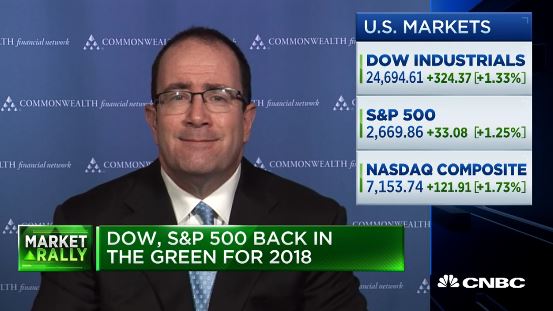
Am I anticipating a Santa Claus rally? Today, I appeared on CNBC's Power Lunch to discuss what we might see in the market over the next couple of weeks.
November 20, 2018
The last post in this series was about the old world, one that was dominated and defined by politics both between and within nation-states. Indeed, the nation-state was the defining entity of the period, with political borders determining economic relationships. But even within nation-states, economic actors were largely constrained by political forces, in the form of laws, regulations, and borders. It was a much smaller world from the perspective of most companies. Your competitors came from your industry, in your country. You knew them, they knew you, and you were all pretty much playing by the same rules and subject to the same constraints.
November 19, 2018
Last week started off with looks at prices and whether inflation is picking up. This week is a short but busy one on the economic front, with reports on housing and durable goods demand.
November 16, 2018
I closed my post two days ago with the observation that the now world—the world optimized around economics—has changed significantly from what came before it. It really became different this time, within the lifetime of most of the readers of this blog.
November 15, 2018
I want to take a break today from the next world discussion to check in on the stock market. Since the pullback in October and the bounce after the midterms, we have seen a slow and continuous decline. I have been hearing more questions and concerns, so let’s take a look at what is going on.
November 15, 2018
Given slowing economic growth, are we looking at a recession? Yesterday, I appeared on CNBC's Power Lunch to discuss what we might expect as we head toward year-end.
We're seeing increased volatility in the market, but what's the outlook for 2019? I discussed this and more (my segment begins at 50:51) yesterday on Bloomberg TV's Bloomberg Daybreak: Americas.
November 14, 2018
As we discussed yesterday, the world is always changing. But in the past couple of years, there has been a growing sense that the changes we’re seeing now go beyond what is normal. From an investment and economic perspective, it seems these changes might be getting systemic enough that, over the next decade or so, it really will be different this time. To understand what might happen next, though, it is important to understand where we are starting from—as the next world will inevitably evolve from the now world.
Episode 13
November 19, 2025
Episode 12
October 14, 2025
Episode 11
September 10, 2025
Episode 10
August 13, 2025
Episode 9
July 23, 2025
The information on this website is intended for informational/educational purposes only and should not be construed as investment advice, a solicitation, or a recommendation to buy or sell any security or investment product. Please contact your financial professional for more information specific to your situation.
Certain sections of this commentary contain forward-looking statements that are based on our reasonable expectations, estimates, projections, and assumptions. Forward-looking statements are not guarantees of future performance and involve certain risks and uncertainties, which are difficult to predict. Past performance is not indicative of future results. Diversification does not assure a profit or protect against loss in declining markets.
The S&P 500 Index is a broad-based measurement of changes in stock market conditions based on the average performance of 500 widely held common stocks. All indices are unmanaged and investors cannot invest directly in an index.
The MSCI EAFE (Europe, Australia, Far East) Index is a free float‐adjusted market capitalization index that is designed to measure the equity market performance of developed markets, excluding the U.S. and Canada. The MSCI EAFE Index consists of 21 developed market country indices.
One basis point (bp) is equal to 1/100th of 1 percent, or 0.01 percent.
The VIX (CBOE Volatility Index) measures the market’s expectation of 30-day volatility across a wide range of S&P 500 options.
The forward price-to-earnings (P/E) ratio divides the current share price of the index by its estimated future earnings.
Third-party links are provided to you as a courtesy. We make no representation as to the completeness or accuracy of information provided on these websites. Information on such sites, including third-party links contained within, should not be construed as an endorsement or adoption by Commonwealth of any kind. You should consult with a financial advisor regarding your specific situation.
Member FINRA, SIPC
Please review our Terms of Use.
Commonwealth Financial Network®