I appeared on Yahoo Finance’s The Final Round to discuss the impact of coronavirus on the market. Listen in to hear more.
The economic data released last week largely came in above forecasts, primarily due to very low expectations by economists rather than significantly better economic activity. This week will be another busy one. We’ll get our first look at first-quarter GDP growth, the personal spending and income reports for March, and the weekly initial jobless claims report. Updates on consumer and manufacturer confidence will also be highlighted.
April 24, 2020
Today, I'd like to discuss where we are in the coronavirus crisis and what that means for the economy and markets. We’ve seen significant progress in terms of the virus, with the daily case growth rate dropping below 4 percent for several days in a row. Further, the number of tests given has risen from about 150,000 to 300,000 per day. As we turn to the economy, the news is more of a mixed bag. Jobless claims are still very high, although this damage may have started to peak. Plus, with measures like the Paycheck Protection Program and stimulus checks, both individuals and businesses are getting some much-needed relief.
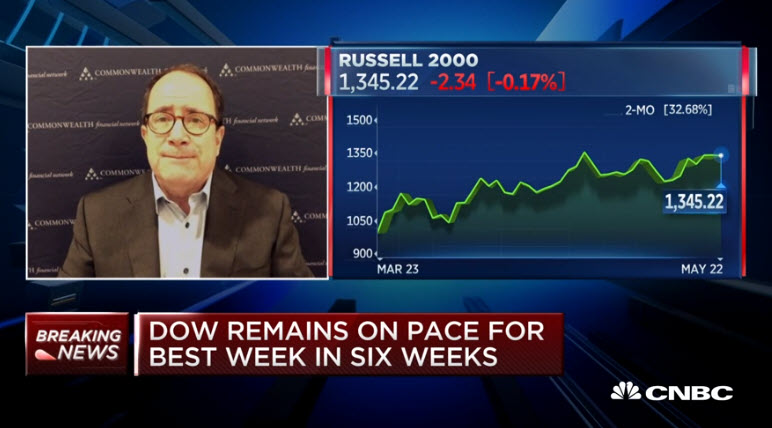
Is the recent market stumble something to worry about? I discuss this and more on CNBC’s The Exchange.
April 23, 2020
Brad here. Today, my colleague Nate Parker, senior investment research analyst on Commonwealth’s Investment Management and Research team, provides insights on the oil markets and why U.S. prices recently dropped into negative territory. Enjoy!
April 22, 2020
Today, I'd like to take another look at where we are with containing the COVID-19 pandemic. Since last week, there has been real progress on many fronts, although concerns remain.
April 21, 2020
Now that it looks like the coronavirus is starting to come under control (and I will do another update here tomorrow), it is time to think about what is coming next for the markets. We have had the fastest onset of a bear market in history, followed by the fastest recovery into a bull market in history. This kind of volatility is, well, historic. But since it is unprecedented, we can’t really look back at history for guidance as to what happens next.
April 20, 2020
The economic data released last week came in largely worse than expected, highlighting the very real headwinds the economy is facing with the majority of the country effectively shut down. March’s retail sales and industrial production reports were two of the most disappointing releases, but the weakness was widespread. This week will again be packed with important reports, with highlights on housing sales, business and consumer sentiment, and business spending. We’ll also look closely at the weekly initial unemployment claims.
April 17, 2020
Today, I'd like to provide an update on the coronavirus crisis, including its effects on the economy and markets. With regard to the virus itself, we’re seeing signs of progress. This week, the daily spread rate dipped below 5 percent, and the number of new cases per day started to stabilize. With this good news on the pandemic front, the focus is shifting to how to reopen the economy. Here, the news is not as good. With more than 22 million jobs lost over the past several weeks and many businesses remaining closed, the damage is mounting.
April 16, 2020
Brad here. In today's post, Peter Essele, vice president of investment management and research, provides some perspective on the latest jobless claims numbers—and what we might expect going forward.
Episode 13
November 19, 2025
Episode 12
October 14, 2025
Episode 11
September 10, 2025
Episode 10
August 13, 2025
Episode 9
July 23, 2025
The information on this website is intended for informational/educational purposes only and should not be construed as investment advice, a solicitation, or a recommendation to buy or sell any security or investment product. Please contact your financial professional for more information specific to your situation.
Certain sections of this commentary contain forward-looking statements that are based on our reasonable expectations, estimates, projections, and assumptions. Forward-looking statements are not guarantees of future performance and involve certain risks and uncertainties, which are difficult to predict. Past performance is not indicative of future results. Diversification does not assure a profit or protect against loss in declining markets.
The S&P 500 Index is a broad-based measurement of changes in stock market conditions based on the average performance of 500 widely held common stocks. All indices are unmanaged and investors cannot invest directly in an index.
The MSCI EAFE (Europe, Australia, Far East) Index is a free float‐adjusted market capitalization index that is designed to measure the equity market performance of developed markets, excluding the U.S. and Canada. The MSCI EAFE Index consists of 21 developed market country indices.
One basis point (bp) is equal to 1/100th of 1 percent, or 0.01 percent.
The VIX (CBOE Volatility Index) measures the market’s expectation of 30-day volatility across a wide range of S&P 500 options.
The forward price-to-earnings (P/E) ratio divides the current share price of the index by its estimated future earnings.
Third-party links are provided to you as a courtesy. We make no representation as to the completeness or accuracy of information provided on these websites. Information on such sites, including third-party links contained within, should not be construed as an endorsement or adoption by Commonwealth of any kind. You should consult with a financial advisor regarding your specific situation.
Member FINRA, SIPC
Please review our Terms of Use.
Commonwealth Financial Network®