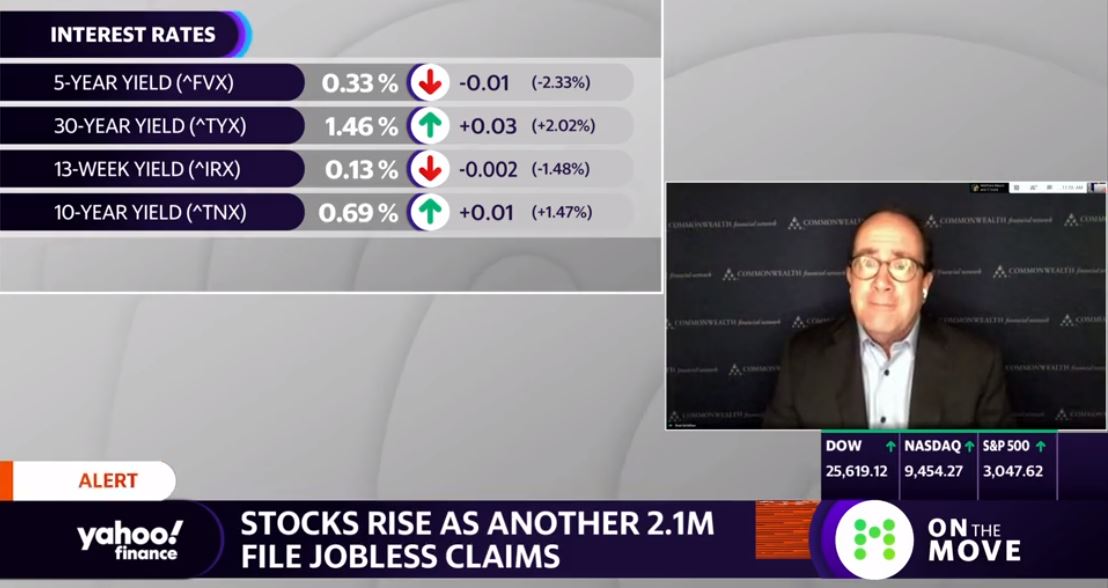
Today’s post on ESG investing comes from Brian Price, senior vice president of investment management and research here at Commonwealth—and a self-proclaimed ESG investing skeptic. Over to you, Brian!
May 20, 2020
Today’s post on ESG investing comes from Brian Price, senior vice president of investment management and research here at Commonwealth—and a self-proclaimed ESG investing skeptic. Over to you, Brian!
Brad here. One of the most common questions I get from investors is where to invest. Stocks, bonds, or something else? Are things different this time, and how should we react? And, perhaps most relevant, should we invest in the U.S. or abroad? Anu Gaggar, Commonwealth’s international analyst, spends her days thinking about how—and whether—to invest abroad, and this post provides a timely and very useful guide to how she is thinking about emerging markets. Thanks, Anu!
Last week’s economic updates continued to show the devastating impact that shelter-in-place orders had on the economy in April, highlighted by historically bad retail sales and industrial production reports. This week will be relatively quiet for economic updates, with the focus on housing, the FOMC minutes, and the weekly initial jobless claims report.
May 15, 2020
Today, I'd like to provide an update on the coronavirus crisis, including the economic and market implications. It was another good week in terms of controlling the virus, with the daily spread rate dropping to less than 2 percent for five days in a row. Plus, testing increased to more than 300,000 tests per day, and the number of new cases per day continued to decline significantly. Similar progress was seen on the economic front. Layoffs continued, but millions of people have started to return to work—one of the positive effects of the reopening process. Of course, risks remain, with a second wave of infections looming the largest. But the foundation of the economy is starting to be rebuilt.
Last week, we took a look at progress in the coronavirus pandemic since the start of April, which has been substantial. What I want to look at today is some very good news from the past week. We saw continued and even accelerated progress on several fronts with the pandemic and are almost into phase 2. For the economy, the rolling reopening has also started to show some positive effects. Financial markets, on the other hand, have had some volatility as the prospect of reopening turns into reality. So, here we go.
May 13, 2020
My colleague Sam Millette, senior investment research analyst on Commonwealth’s Investment Management and Research team, has helped me put together this month’s Market Risk Update. Thanks for the assist, Sam!
May 12, 2020
My colleague Sam Millette, senior investment research analyst on Commonwealth’s Investment Management and Research team, has helped me put together this month’s Economic Risk Factor Update. Thanks for the assist, Sam!
The highlights of last week’s economic news were reports on trade, service sector confidence, and the jobs market. This week will be another busy one for updates, with releases scheduled on inflation, retail sales, industrial production, and consumer sentiment.
May 8, 2020
Today, I'd like to take a look back over the past month to evaluate how far we’ve come in the coronavirus crisis. We’ve seen real progress in terms of the pandemic, with daily spread rates going from 15 percent at the start of April to less than 3 percent in recent days. Plus, the daily testing rate has doubled in that same time period, with the number of positive test results declining. We’re also making progress on the economic front. The news here isn’t necessarily good, but we could say it’s getting less bad. Weekly layoffs have started to trend down, federal stimulus programs have gone into effect, and a number of states have begun to reopen. The markets have taken note of these shifts and fully expect a V-shaped recovery.
The two keywords for last week’s update were “continued progress,” and those would work for this week as well. As this is the first update for May, however, let’s take a look at the progress over the past month, since the start of April. While weekly data is useful, the pandemic has now continued on for long enough that we have the data to establish a broader context—and that broader context is surprisingly positive.
Episode 14
December 17, 2025
Episode 13
November 19, 2025
Episode 12
October 14, 2025
Episode 11
September 10, 2025
Episode 10
August 13, 2025
The information on this website is intended for informational/educational purposes only and should not be construed as investment advice, a solicitation, or a recommendation to buy or sell any security or investment product. Please contact your financial professional for more information specific to your situation.
Certain sections of this commentary contain forward-looking statements that are based on our reasonable expectations, estimates, projections, and assumptions. Forward-looking statements are not guarantees of future performance and involve certain risks and uncertainties, which are difficult to predict. Past performance is not indicative of future results. Diversification does not assure a profit or protect against loss in declining markets.
The S&P 500 Index is a broad-based measurement of changes in stock market conditions based on the average performance of 500 widely held common stocks. All indices are unmanaged and investors cannot invest directly in an index.
The MSCI EAFE (Europe, Australia, Far East) Index is a free float‐adjusted market capitalization index that is designed to measure the equity market performance of developed markets, excluding the U.S. and Canada. The MSCI EAFE Index consists of 21 developed market country indices.
The Dow Jones Industrial Average is computed by summing the prices of the stocks of 30 large companies and then dividing that total by an adjusted value, one which has been adjusted over the years to account for the effects of stock splits on the prices of the 30 companies. Dividends are reinvested to reflect the actual performance of the underlying securities.
The Russell 2000 is a market-capitalization weighted index, with dividends reinvested, that consists of the 2,000 smallest companies within the Russell 3000 Index. It is often used to track the performance of U.S. small market capitalization stocks.
One basis point (bp) is equal to 1/100th of 1 percent, or 0.01 percent.
The VIX (CBOE Volatility Index) measures the market’s expectation of 30-day volatility across a wide range of S&P 500 options.
The forward price-to-earnings (P/E) ratio divides the current share price of the index by its estimated future earnings.
Third-party links are provided to you as a courtesy. We make no representation as to the completeness or accuracy of information provided on these websites. Information on such sites, including third-party links contained within, should not be construed as an endorsement or adoption by Commonwealth of any kind. You should consult with a financial advisor regarding your specific situation.
Member FINRA, SIPC
Please review our Terms of Use.
Commonwealth Financial Network®