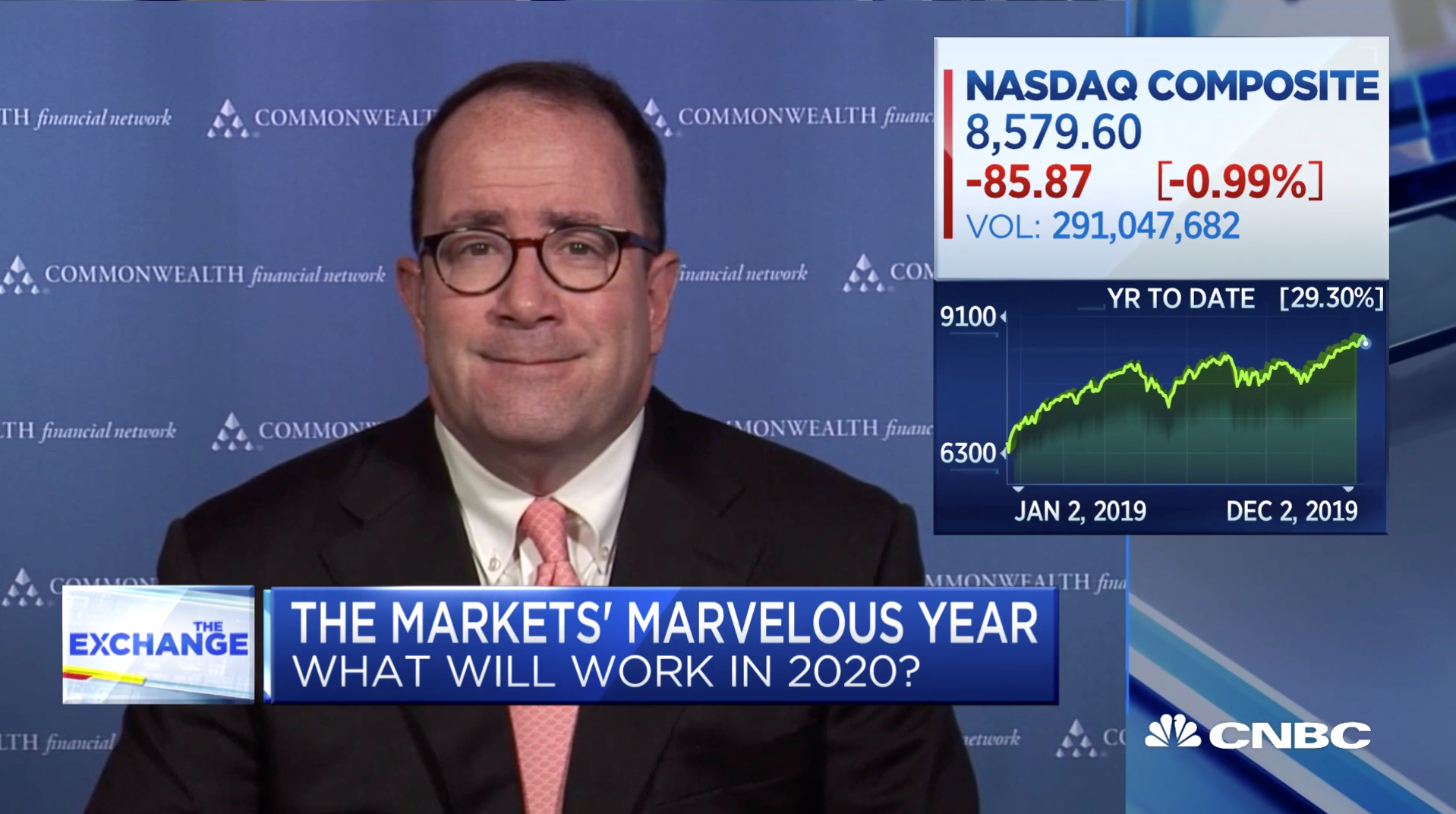
Is the market trading on fundamentals or politics? I discussed this and more today on Yahoo Finance’s On the Move.
November 6, 2019
My colleague Sam Millette, senior investment research analyst on Commonwealth’s Investment Management and Research team, has helped me put together this month’s Economic Risk Factor Update. Thanks for the assist, Sam!
The economic data released in October largely came in better than expected, with increasing service sector and consumer confidence offsetting some of the declines we saw in September. Job creation also came in better than anticipated, and the yield curve normalized for the first time in months. Despite these positive results, the longer-term trends continue to deteriorate, suggesting there are still very real risks in the economy that should be monitored going forward.
November 5, 2019
September and October are historically the two weakest months of the year, and markets did enter October in a nervous state. September ended on a positive note, but there was a drop that continued into the start of October. That decline took away all of the gains from the prior month and threatened to take the markets even lower. This move would have made sense, as the economic news was weakening. But markets went on to rebound and have a very good month. That reversal is the story of last month and very possibly of this one.
Last week was jam-packed with economic updates, many of which beat expectations. Faster-than-expected GDP growth in the third quarter and a stronger-than-expected October employment report highlighted a week in which the Fed cut the federal funds rate by 25 bps. This week will be quieter, with notable releases on international trade, the service sector, and consumer confidence.
November 1, 2019
October was a great month, with U.S. markets doing well and international markets doing even better. This positive news was surprising, given the impeachment inquiry, weak job growth, and declining business confidence. Still, major sectors of the economy remain strong. Consumers continue to earn and spend more. Plus, the Fed has gotten behind the markets with rate cuts at its last two meetings. But is there volatility ahead? Watch my latest Market Thoughts video to learn more.
October 31, 2019
Yesterday, the Fed announced that it was cutting rates one more time, in response to continued economic weakness. That decision was the treat. Markets responded accordingly, with stock markets rising. The trick, however, was in the implication—of the statement and the press conference—that this would be the last cut unless the economy deteriorated further. The implied probability of a December rate cut dropped to 22 percent, the dollar index dropped, and the rate on the 10-year Treasury declined. The Fed giveth and the Fed taketh away.
October 30, 2019
There is a lot of economic data coming out this week: consumer confidence, third-quarter economic growth, personal income and spending, the ISM Manufacturing number, the jobs report on Friday, and, of course, the Fed’s decision on interest rates (which, if you haven't heard, resulted in another quarter-point cut this afternoon). We will get a much better understanding of where we are by the end of the week, and we will talk about what all that data means.
October 29, 2019
Yesterday, the market—or at least the S&P 500 and the Nasdaq 100—hit new records. Again. But should we care? And do these most recent highs tell us anything about the future?
October 28, 2019
Last week’s economic updates largely disappointed, with housing sales, durable goods orders, and consumer confidence all declining. Upon closer inspection, however, we found some positive developments, with continued year-over-year housing growth as a highlight. This week will be very busy, with the Fed’s October rate-setting meeting, the first report on third-quarter GDP growth, and the October jobs report all on the docket.
October 25, 2019
One of the topics I get a lot of questions about when speaking to clients is the trade war. They want to know what I think and whether whatever they’ve read in the latest headline will make a big difference. It has been a remarkably consistent question, through all the ups and downs, and the only difference is what exactly the latest headline is. My answer has also been consistent. I think the trade war is a big deal, but the latest headline doesn’t really matter. Why? Because the damage has already been done. It will just take a while to show up.
Episode 13
November 19, 2025
Episode 12
October 14, 2025
Episode 11
September 10, 2025
Episode 10
August 13, 2025
Episode 9
July 23, 2025
The information on this website is intended for informational/educational purposes only and should not be construed as investment advice, a solicitation, or a recommendation to buy or sell any security or investment product. Please contact your financial professional for more information specific to your situation.
Certain sections of this commentary contain forward-looking statements that are based on our reasonable expectations, estimates, projections, and assumptions. Forward-looking statements are not guarantees of future performance and involve certain risks and uncertainties, which are difficult to predict. Past performance is not indicative of future results. Diversification does not assure a profit or protect against loss in declining markets.
The S&P 500 Index is a broad-based measurement of changes in stock market conditions based on the average performance of 500 widely held common stocks. All indices are unmanaged and investors cannot invest directly in an index.
The MSCI EAFE (Europe, Australia, Far East) Index is a free float‐adjusted market capitalization index that is designed to measure the equity market performance of developed markets, excluding the U.S. and Canada. The MSCI EAFE Index consists of 21 developed market country indices.
One basis point (bp) is equal to 1/100th of 1 percent, or 0.01 percent.
The VIX (CBOE Volatility Index) measures the market’s expectation of 30-day volatility across a wide range of S&P 500 options.
The forward price-to-earnings (P/E) ratio divides the current share price of the index by its estimated future earnings.
Third-party links are provided to you as a courtesy. We make no representation as to the completeness or accuracy of information provided on these websites. Information on such sites, including third-party links contained within, should not be construed as an endorsement or adoption by Commonwealth of any kind. You should consult with a financial advisor regarding your specific situation.
Member FINRA, SIPC
Please review our Terms of Use.
Commonwealth Financial Network®