Yesterday, I appeared on Yahoo Finance’s The Final Round to discuss recent market declines, including what to expect going forward. Listen in to hear more.


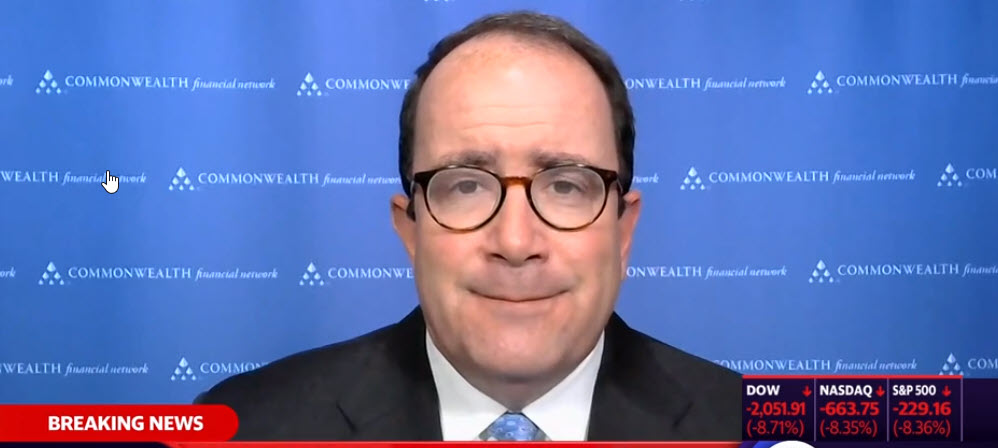
Yesterday, I appeared on Yahoo Finance’s The Final Round to discuss recent market declines, including what to expect going forward. Listen in to hear more.
March 12, 2020
My son has a stuffed bear he got when he was quite small (from Commonwealth, as it happens). We used to play a game where the bear would sneak up on him. “Where bear? There bear!” Well, the bear is now here. We have finally seen the end of the bull market, with the Dow dropping 20 percent from its highs and the S&P 500 following today. We are officially in a bear market, with all that implies. Stock markets around the world are down again today on the news.

March 11, 2020
My colleague Sam Millette, senior investment research analyst on Commonwealth’s Investment Management and Research team, has helped me put together this month’s Economic Risk Factor Update. Thanks for the assist, Sam!

March 10, 2020
In early March, we saw markets drop worldwide. In fact, the 7.5 percent decline on March 9—which, coincidentally, happens to be the 11th anniversary of the bull market—was the largest since 2008. With a total decline of almost 19 percent, in less than a month, this certainly looks like a crash—doesn’t it?

Last week’s economic updates showed surprising economic strength in February, highlighted by improving business confidence and an unexpectedly strong February jobs report. In March, confidence figures are likely to decline, due to the global spread of the coronavirus. Nonetheless, before that crisis emerged, the recent updates pointed toward an improving economy poised for faster growth. This week will be relatively quiet on the economic update front. Economists will, however, be closely monitoring the preliminary consumer confidence report set to be released on Friday, which will be our first look at consumer confidence in March.

In January, members of Commonwealth’s Investment Management and Research team traveled to Florida for the Inside ETFs conference, which has become the world’s largest conference on this topic. We met with and heard from industry experts and a number of ETF providers, and we networked with peers from other firms to discuss the latest trends within the ETF industry. Every year, a couple of topics seem to dominate the discussions. This year, without question, the two hottest topics were the emergence of nontransparent actively managed ETFs and the surge in environmental, social, and governance (ESG) investing.

March 5, 2020
Monday, March 9, will be the 11th anniversary of the bull market that started back in 2009. With recent pullbacks and turbulence around the coronavirus, it is reasonable to worry that this anniversary will be the last and that a bear market will break the streak sometime in the next year. As such, now seems a good time to consider where we stand—and where the market might be headed.
March 4, 2020
I know I am coming a bit late to the party on this, as there has already been a great deal of commentary and reaction to yesterday’s unexpected move by the Fed to cut interest rates by half a percentage point. Markets dropped after the announcement, but we are now seeing a strong rally. Pundits are on all sides of the issue. So, what’s really going on?
Although investor attention has been focused on concerns about the coronavirus and the equity market sell-off, last week’s economic updates showed surprising strength. The highlights of this week’s data releases will be reports on business confidence, international trade, and jobs.
March 2, 2020
February was a tough month. Both U.S. and international markets dropped sharply at month-end, as the coronavirus continued to spread across the globe. While the declines are worrisome, previous outbreaks, like Zika and SARS, have resulted in similar outcomes. As such, the markets’ response to the coronavirus can actually be considered normal.