Over the past couple of days, I’ve had several conversations about investing. Nothing new there, but a question came up that deserved some serious thought: What do you really believe, or really know, about investing?
May 27, 2015
Over the past couple of days, I’ve had several conversations about investing. Nothing new there, but a question came up that deserved some serious thought: What do you really believe, or really know, about investing?
May 26, 2015
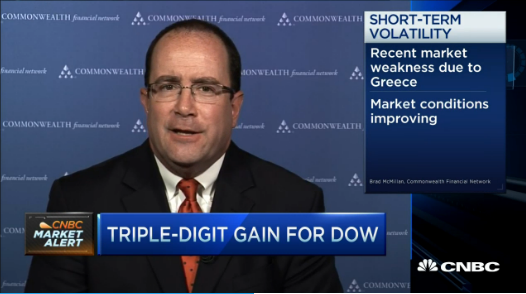
I spent this morning reviewing today's economic news in preparation for a TV appearance. I didn't have much of a chance to focus on it in the interview, but fortunately we can discuss it here. The news wasn’t just good, but good in an interesting way.
Where's the best place for your money today?
That's the question I discussed this morning with Opening Bell host Maria Bartiromo on Fox Business Network. Hear my thoughts on how to position your portfolio.
May 22, 2015
“In Flanders fields the poppies blow / Between the crosses, row on row . . .” — John McCrae
I was in London late last year and had the chance to see the poppy exhibition at the Tower of London. A red ceramic poppy stood for every one of 888,246 soldiers of the British Commonwealth who died in World War I, filling the fields around the Tower.
May 21, 2015
I’ve been away speaking at Commonwealth conferences for the past 10 days, which were (as usual) a tremendous amount of fun. I even had the chance to take my parents to the last one, in Naples, Florida. They found—and I rediscovered—that there’s no nicer group of people than Commonwealth advisors and staff. I’m tremendously grateful for the opportunity to hang out with these folks, and to show my parents my world.
May 20, 2015
In this last post on rising interest rates, let's talk about what everyone really wants to know: What do rising rates mean for our investments? As we discussed yesterday, a rate hike probably isn’t imminent, but it’s certainly worth thinking about to get ahead of the risk.
May 19, 2015
Yesterday, we discussed what the natural interest rate should be, arriving at about 5 percent on a nominal basis, assuming 2-percent inflation. That seems like a reasonable number over time, given that the Federal Reserve has committed to an inflation target of 2 percent. But with interest rates currently far below 3 percent, there’s clearly a gap between what the rate should be and where it is now.
With stocks hitting new highs today, even as the pace of economic growth seems to be slowing, much of the market’s strength appears to be coming from the continued low interest rates provided by the Federal Reserve. Although we don’t know when rates will rise, the general consensus seems to be that it will happen sometime this year.
With that in mind, it’s time to take another look at what happens when rates start to rise, a topic I originally addressed last year.
May 15, 2015
As I noted yesterday, President Obama and Mitch McConnell, the Senate majority leader, are working to move a new free trade agreement through Congress, based on a shared conviction that it is good for the country. Many Democrats, who do not share that conviction, are fighting it.
To understand what the stakes are here, and what the different sides are fighting for, let’s take a deeper look at how free trade works and how its benefits are distributed.
May 14, 2015
For the first time in a while, the U.S. has a major free trade agreement on the agenda. Trade is an interesting intersection of economics and politics, as we’ve seen in today’s news, which features President Obama and the Senate majority leader, Mitch McConnell, working together for the first time in, well, ever, to overcome Democrats’ objections.
Episode 14
December 17, 2025
Episode 13
November 19, 2025
Episode 12
October 14, 2025
Episode 11
September 10, 2025
Episode 10
August 13, 2025
The information on this website is intended for informational/educational purposes only and should not be construed as investment advice, a solicitation, or a recommendation to buy or sell any security or investment product. Please contact your financial professional for more information specific to your situation.
Certain sections of this commentary contain forward-looking statements that are based on our reasonable expectations, estimates, projections, and assumptions. Forward-looking statements are not guarantees of future performance and involve certain risks and uncertainties, which are difficult to predict. Past performance is not indicative of future results. Diversification does not assure a profit or protect against loss in declining markets.
The S&P 500 Index is a broad-based measurement of changes in stock market conditions based on the average performance of 500 widely held common stocks. All indices are unmanaged and investors cannot invest directly in an index.
The MSCI EAFE (Europe, Australia, Far East) Index is a free float‐adjusted market capitalization index that is designed to measure the equity market performance of developed markets, excluding the U.S. and Canada. The MSCI EAFE Index consists of 21 developed market country indices.
The Dow Jones Industrial Average is computed by summing the prices of the stocks of 30 large companies and then dividing that total by an adjusted value, one which has been adjusted over the years to account for the effects of stock splits on the prices of the 30 companies. Dividends are reinvested to reflect the actual performance of the underlying securities.
The Russell 2000 is a market-capitalization weighted index, with dividends reinvested, that consists of the 2,000 smallest companies within the Russell 3000 Index. It is often used to track the performance of U.S. small market capitalization stocks.
One basis point (bp) is equal to 1/100th of 1 percent, or 0.01 percent.
The VIX (CBOE Volatility Index) measures the market’s expectation of 30-day volatility across a wide range of S&P 500 options.
The forward price-to-earnings (P/E) ratio divides the current share price of the index by its estimated future earnings.
Third-party links are provided to you as a courtesy. We make no representation as to the completeness or accuracy of information provided on these websites. Information on such sites, including third-party links contained within, should not be construed as an endorsement or adoption by Commonwealth of any kind. You should consult with a financial advisor regarding your specific situation.
Member FINRA, SIPC
Please review our Terms of Use.
Commonwealth Financial Network®