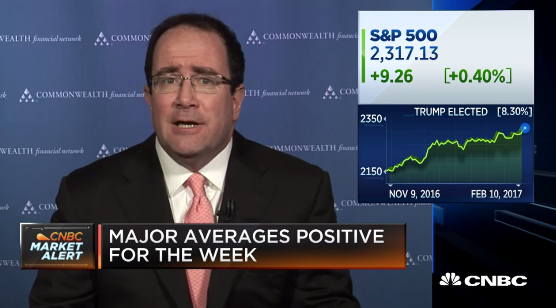
In the early days post-inauguration, will financials keep doing well? Will we continue to see the kind of outperformance that we’ve witnessed recently?
January 20, 2017
Today, America carried out the peaceful transition of power that is at the heart of our democracy—except that we don’t actually have a democracy but a republic. In a democracy, the people make the decisions. In a republic, they elect representatives who make the decisions for them. This is a subtle but important difference, and one that represents a very deliberate decision by the founders, who distrusted popular sentiment.
January 19, 2017
In yesterday’s post, I discussed how corporate earnings will likely continue to improve, which should be good for the stock market on a fundamental basis. That’s not the whole story, however.
January 18, 2017
The key driver of the stock market, over the long term, is earnings. In the short term as well, earnings can be the primary driver of market performance. So, each quarter, it makes sense to review whether earnings are doing well or poorly, and why.
January 17, 2017
After a strong start, 2017 slowed down considerably in terms of economic data. Last week’s news, which centered on the consumer, largely disappointed. Although it’s too early to get very concerned, the numbers suggest that higher confidence levels aren’t yet translating into actual growth.
January 13, 2017
Just as I do with the economy, I review the market each month for warning signs of trouble in the near future.
January 12, 2017
The news this month continues to be good, with more positive data almost across the board. This is the second month of reversal against the downtrend that developed in 2016, which suggests a real change of course. Although we need more data to be fully confident, the consistency of the positive reversal across multiple data sets and the magnitude of the positive surprises are very encouraging.
January 11, 2017
Rereading some of my recent posts, it occurred to me that I’ve talked quite a bit about “confidence” (and the improvements thereof) without actually defining what I mean by it. Much of social science, and economics, is based on hand-waving, so when you have actual data, it makes sense to employ it.
January 10, 2017
Recently, several readers have written in questioning the current optimism about the economy. Is it sustainable, and is it realistic to expect faster growth?
January 9, 2017
2016 ended with a bang, as the Conference Board’s consumer confidence survey once again surprised to the upside. Coming in at 113.7 for December—up from 107.1 and beating expectations of 109—this is the highest level since 2001, suggesting that consumers are increasingly optimistic, despite weak personal income and expense growth.
Episode 14
December 17, 2025
Episode 13
November 19, 2025
Episode 12
October 14, 2025
Episode 11
September 10, 2025
Episode 10
August 13, 2025
The information on this website is intended for informational/educational purposes only and should not be construed as investment advice, a solicitation, or a recommendation to buy or sell any security or investment product. Please contact your financial professional for more information specific to your situation.
Certain sections of this commentary contain forward-looking statements that are based on our reasonable expectations, estimates, projections, and assumptions. Forward-looking statements are not guarantees of future performance and involve certain risks and uncertainties, which are difficult to predict. Past performance is not indicative of future results. Diversification does not assure a profit or protect against loss in declining markets.
The S&P 500 Index is a broad-based measurement of changes in stock market conditions based on the average performance of 500 widely held common stocks. All indices are unmanaged and investors cannot invest directly in an index.
The MSCI EAFE (Europe, Australia, Far East) Index is a free float‐adjusted market capitalization index that is designed to measure the equity market performance of developed markets, excluding the U.S. and Canada. The MSCI EAFE Index consists of 21 developed market country indices.
One basis point (bp) is equal to 1/100th of 1 percent, or 0.01 percent.
The VIX (CBOE Volatility Index) measures the market’s expectation of 30-day volatility across a wide range of S&P 500 options.
The forward price-to-earnings (P/E) ratio divides the current share price of the index by its estimated future earnings.
Third-party links are provided to you as a courtesy. We make no representation as to the completeness or accuracy of information provided on these websites. Information on such sites, including third-party links contained within, should not be construed as an endorsement or adoption by Commonwealth of any kind. You should consult with a financial advisor regarding your specific situation.
Member FINRA, SIPC
Please review our Terms of Use.
Commonwealth Financial Network®