Overall, the economic news last week was balanced. In this Monday Update, I’ll review the good and the bad, as well as what to watch for in the week ahead.


October 19, 2015
Overall, the economic news last week was balanced. In this Monday Update, I’ll review the good and the bad, as well as what to watch for in the week ahead.
We know the Federal Reserve is worried about inflation being too low, and yesterday’s figures seem to substantiate that fear. With headline inflation over the past month down by 0.2 percent, and flat over the past year, it seems that prices are indeed just sitting there.
October 16, 2015
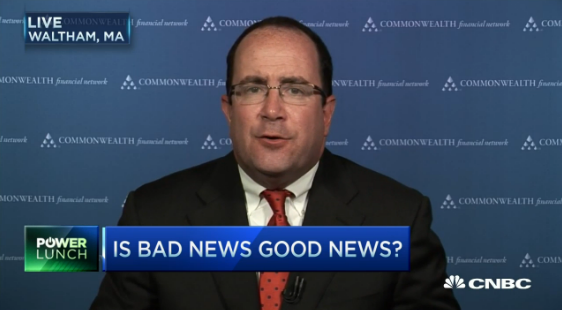
Walmart's expected earnings decline is bad news for the company, but could it actually be good news for consumers? Learn what I think about Walmart's decision to raise wages, which I discussed in an appearance Wednesday on CNBC's Power Lunch program.

October 15, 2015
One of yesterday’s big news stories was the surprise announcement by Walmart that, instead of growing by 4 percent (as expected), earnings per share were expected to decline by between 6 percent and 12 percent in fiscal year 2017. Shares, of course, dropped substantially, and the market as a whole took note. Lower earnings are bad, right? For the company, and quite possibly for the market, this is certainly true. But is it bad for the economy and the country? I don’t think so.

October 14, 2015
The Trans-Pacific Partnership (TPP) is a major trade agreement among 12 countries, including most of the major economic powers in Asia, along with the U.S.—but notably excluding China. After five years of negotiations, the participating parties reached accord on October 5, and the agreement is now working its way toward approval in the various national legislatures. But is the TPP a good idea?
October 13, 2015
There are two components to stock markets: earnings and how much investors are willing to pay for them. Recently, much of the commentary has been on valuations, with the implicit assumption that earnings would more or less take care of themselves. Although this has been the case for the past several years, at least on a per-share basis, one of my colleagues and an investment research associate, Sam Millette, recently pulled some figures that gave me pause.
October 12, 2015
Overall, last week’s data came in generally positive, but in this Monday update, I highlight some economic news in the week ahead that may be cause for concern.
October 9, 2015
Sometimes, I really hate being right. A few weeks ago, I wrote that the Washington, DC, political environment had deteriorated and that the current go-round on the debt ceiling was likely to be even more contentious than the last one, two years ago. Sure enough, with the resignation of Speaker John Boehner—and the withdrawal yesterday of his heir apparent—the House appears ungovernable. Without some type of Republican internal agreement on at least whom to elect as speaker, it’s hard to see any resolution to the debt ceiling debate, which is likely going to hit in the next couple of weeks.

October 8, 2015
I wrote yesterday about the economy and how I believe that, while we are seeing some weak data, we are likely experiencing a temporary “snowdown” (much as we saw the past two winters) rather than a true slowdown. Still, we have to ask ourselves, Is the market pullback similarly temporary, or is it the first stage of a deeper correction?
There has been a lot of talk in the financial media about an economic slowdown, with a sense—explicit in some cases—that a recession is a real possibility. Some of that talk, I will admit, has come from me. Given some of the recent bad reports, particularly the jobs report, I do feel that there is a possibility that the trend has changed. After giving it a lot of thought, though, I do not think this is what’s actually happening.