The Independent Market Observer

12/17/12 - GOP to Millionaires: Drop Dead!

December 17, 2012

That’s an unfair headline, but what the heck. The big political and economic news in the U.S. this weekend was Speaker Boehner’s offer to allow higher tax rates on those making more than $1 million per year. That at least was the headline. But buried in the proposal was something more significant—an offer to extend the debt ceiling for at least another year or so.

The GOP—at least the portion of it not in safe, gerrymandered districts—is starting to recognize that, if the country does go off the cliff, the Democrats will get a lot of what their base wants—higher taxes, especially on the “rich,” and lower military spending—and the Republicans will get blamed by the Independents. Sure the country will suffer, but from a political point of view it doesn’t get much better than that for the Democrats. Boehner, who is speaking for the wing of the GOP that will be exposed in the next election cycle, is trying to cut a deal—or at least look as if he is doing so. As predicted, this is coming at the last minute.

Continue reading → Leave a comment

12/14/12 – The Economy Slowly Continues to Improve, Despite Washington

December 14, 2012

Probably the best description of a movie I’ve ever read was of Independence Day, a great science fiction B movie. (If you haven’t seen it and you like that sort of thing, take a look.) The description goes, “Space aliens come and destroy Washington, D.C. But later on, it turns out they are hostile.”

I think of that every time I look at the performance of the economy, which is recovering, and then read the headlines about the fiscal cliff negotiations, or lack thereof. There are certainly risks out there that could derail the recovery, but it’s maddening that the biggest one is our own government.

Continue reading → Leave a comment

12/13/12 - Santa Is Real After All—Up to a Point

December 13, 2012

So the big story today is that the Federal Reserve is now explicitly linking its interest rates to U.S. unemployment. It’s kind of the reverse of the Santa revelation. Remember when you found out that Santa wasn’t real? How you kind of knew it but weren’t happy to have it confirmed? Now we kind of knew that the Fed was keying on unemployment, but again we’re not all that happy to have it confirmed.

The story made the front pages of the Financial Times, the Wall Street Journal, and the New York Times, in all cases above the fold. So in the eyes of the mainstream—and especially the financial—media, this is a big deal. I agree, for a change. The Fed has explicitly moved toward supporting the real economy, in employment, and away from supporting the financial economy, with inflation. Clearly, it is worried more about the former than the latter.

Continue reading → Leave a comment

12/12/12 – Twilight of the Unions?

December 12, 2012

The primary story today is the imposition of restrictions on unions in Michigan, home of the United Auto Workers and once seen as a mainstay of the union movement. This news hit the front pages of the Wall Street Journal, with “Unions Dealt Blow in UAW’s Home State,” and the New York Times, with “Limits on Unions Pass in Michigan, Once a Mainstay.”

The story is important for the obvious reasons, such as the continuing erosion of worker power, but it is also important for some less obvious ones. Among these is that the erosion of wage bargaining power makes general price inflation less likely. A key driver of the out-of-control inflation in the U.S. during the 1970s was the wage-price spiral. At the time, wages were indexed to increase with prices, largely through union contracts, and the two fed each other in an increasing spiral. Today, as the membership and power of unions erode, wage-price inflation is becoming less of a worry for the economy as a whole.

Continue reading → Leave a comment

12/11/12 - Interesting Things to Read

December 11, 2012

Just a quick note regarding some of the more interesting things I have read recently.

Continue reading → Leave a comment

12/11/12 – Y2.013K?

December 11, 2012

I have spent quite a bit of time reading, thinking, and writing about the fiscal cliff, going into its potential risks and damage in some depth. While it’s certainly appropriate to analyze the situation, something occurred to me the other day: Could this be another Y2K?

You may remember it—the disaster that didn’t happen. Despite the predictions of nuclear power stations melting down and airliners dropping from the sky, the millennial New Year celebrations went just fine, and the world was still there the next day.

Continue reading → Leave a comment

12/10/12 – Update on the Rest of the World

December 10, 2012

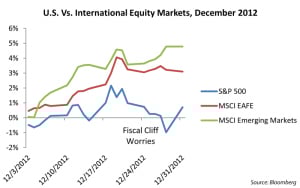
Recently, my posts have focused on the U.S., as that’s where most of the news has been, but I wanted to take a look at the rest of the world. Although nothing particularly urgent is happening, many issues we have discussed before continue to cook.

Europe

Continue reading → Leave a comment

12/10/12 – Consumers Start to Get Worried

December 10, 2012

I have written before about the disconnect between consumers, who have been spending as if the fiscal cliff didn’t exist, and business, which has cut back. That disconnect is starting to disappear as consumers become aware of the cliff and what it could mean.

Consumer confidence showed a material drop at the end of last week, due largely to growing public awareness that after-tax incomes will take a hit if the cliff isn’t averted. Other factors included gas prices and the stock market, both of which hit the expectations component. Looking forward, if confidence stays lower, we can expect consumer spending to drop as well—a problem, as it has been a major sustaining element of the recovery. A front-page story in the Wall Street Journal, “Consumer Spending Wobbles,” notes that spending was slower over the summer than previously believed and has continued to weaken into the end of the year.

Continue reading → Leave a comment

12/10/12 – Possible Outcomes of This Week’s Fed Meeting

December 10, 2012

— Fred DeBaets

On Wednesday, we expect the Fed to announce the continuation of Treasury purchases to replace the current maturity extension program, better known as Operation Twist. The Fed will likely grow the balance sheet at a rate of $45 billion per month, maintaining the current pace of purchases. As for the time frame, our best guess is that the new program will end approximately six months prior to the anticipated rate hike, currently projected as mid-2015 by the Fed and early 2016 by the Fed futures market.

Continue reading → Leave a comment

12/7/12 – Re-Shoring Gets a High-Profile Win

December 7, 2012

I have been writing about re-shoring for a while—most recently, yesterday. Today, front-page news in the New York Times and Financial Times, and front-business-page news in the Wall Street Journal, supports that theme in a big way. Apple has decided to start moving production of Macs back to the U.S.

The company plans to invest about $100 million to start manufacturing Macs here, beyond the assembly work it already does. Tim Cook, the CEO, explicitly says that he plans to work with partners to manufacture the full range of components in the computers.

Continue reading → Leave a comment

Subscribe via Email

AI_Community_Podcast_Thumb - 1


Episode 14
December 17, 2025

Episode 13
November 19, 2025

Episode 12
October 14, 2025

Episode 11
September 10, 2025

Episode 10
August 13, 2025

More


Hot Topics


New Call-to-action

Archives

see all

Subscribe


Disclosure

The information on this website is intended for informational/educational purposes only and should not be construed as investment advice, a solicitation, or a recommendation to buy or sell any security or investment product. Please contact your financial professional for more information specific to your situation.

Certain sections of this commentary contain forward-looking statements that are based on our reasonable expectations, estimates, projections, and assumptions. Forward-looking statements are not guarantees of future performance and involve certain risks and uncertainties, which are difficult to predict. Past performance is not indicative of future results. Diversification does not assure a profit or protect against loss in declining markets.

The S&P 500 Index is a broad-based measurement of changes in stock market conditions based on the average performance of 500 widely held common stocks. All indices are unmanaged and investors cannot invest directly in an index.

The MSCI EAFE (Europe, Australia, Far East) Index is a free float‐adjusted market capitalization index that is designed to measure the equity market performance of developed markets, excluding the U.S. and Canada. The MSCI EAFE Index consists of 21 developed market country indices.

One basis point (bp) is equal to 1/100th of 1 percent, or 0.01 percent.

The VIX (CBOE Volatility Index) measures the market’s expectation of 30-day volatility across a wide range of S&P 500 options.

The forward price-to-earnings (P/E) ratio divides the current share price of the index by its estimated future earnings.

Third-party links are provided to you as a courtesy. We make no representation as to the completeness or accuracy of information provided on these websites. Information on such sites, including third-party links contained within, should not be construed as an endorsement or adoption by Commonwealth of any kind. You should consult with a financial advisor regarding your specific situation.

Member FINRASIPC

Please review our Terms of Use

Commonwealth Financial Network®