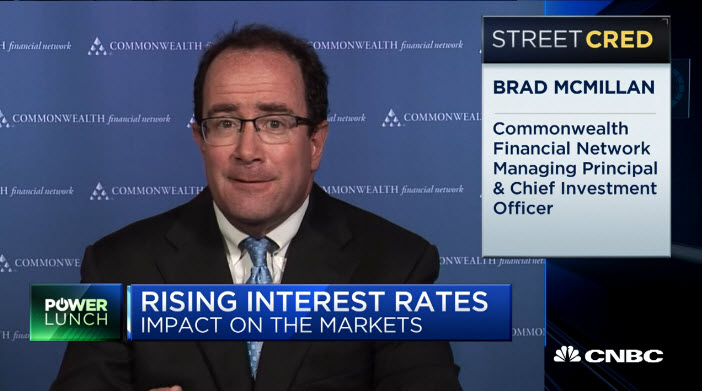
On Thursday, I appeared on CNBC's Power Lunch to discuss the current state of the market, rising rates, and investor skepticism. Overall, things are good, so how much better can they get? Listen in to learn more.
May 17, 2018
We closed yesterday’s post on whether markets are efficient with the conclusion that it could be possible to beat the market. But, to do so, we would need either better information or to view things differently—specifically referencing time horizons as one way to do that. Let’s start with a couple of areas where better information is a real possibility. Then, we’ll take a deeper look at the second idea, which is both more subtle and more interesting.
May 16, 2018
We closed yesterday’s post on how to invest with the question of whether markets were efficient—and what that would mean for how we invest. A foundational assumption of most investment theories is that markets are efficient, which is to say that all information is reflected in an asset’s price. If this holds true, then it shouldn’t be possible to beat the market because—by definition—everything that could affect prices is already accounted for.
May 15, 2018
Given what I do all day, you might imagine I have this investing thing all figured out. In fact, I probably wrestle with it more than most people. Part of what I do is think about many different types of investments and strategies. With all of those options in my head, it can be hard to make decisions about what is best, for me, at any given time and situation. Right now, for instance, I am in the process of putting what is (for me) a largish amount of cash to work. Do I buy in, despite my concerns about valuations? Do I wait and forgo any interim returns? If I decide to buy in, what should I buy?
May 14, 2018
Last week was largely focused on prices, although we got a look at consumer confidence. This week, we’ll be watching the economic data to see whether earlier signs of a slowdown are passing.
May 11, 2018
After writing yesterday’s post on the price of oil, I thought it might be useful to take a longer-term look at the behavior of oil. I think this will provide some context to yesterday’s discussion, as well as to future developments. To start, let’s look at the price history over the past 30 years.
May 10, 2018
Oil has been in the news quite a bit recently. Prices have risen to multiyear highs, and the recent decision by the U.S. to reimpose sanctions on Iran has rattled markets even further. We know that oil prices are a key risk indicator for the economy, but is it time to start worrying? Plus, what do higher oil prices mean—if anything—for the financial markets?
As we start moving further into May, I think it’s a good time to take a look back at April’s economic news, plus what to expect in the month ahead.
May 8, 2018
Market risks come in three flavors: recession risk, economic shock risk, and risks within the market itself. So, what do these risks look like for May? Let’s take a closer look at the numbers.
May 7, 2018
Last week was an extremely busy one for economic news, which gave us a look at all major sectors and concluded with the all-important employment report. Overall, while the economic statistics remain quite positive, there are signs of slowing. This week, the main focus will be on prices, plus we’ll get a look at consumer confidence.
Episode 13
November 19, 2025
Episode 12
October 14, 2025
Episode 11
September 10, 2025
Episode 10
August 13, 2025
Episode 9
July 23, 2025
The information on this website is intended for informational/educational purposes only and should not be construed as investment advice, a solicitation, or a recommendation to buy or sell any security or investment product. Please contact your financial professional for more information specific to your situation.
Certain sections of this commentary contain forward-looking statements that are based on our reasonable expectations, estimates, projections, and assumptions. Forward-looking statements are not guarantees of future performance and involve certain risks and uncertainties, which are difficult to predict. Past performance is not indicative of future results. Diversification does not assure a profit or protect against loss in declining markets.
The S&P 500 Index is a broad-based measurement of changes in stock market conditions based on the average performance of 500 widely held common stocks. All indices are unmanaged and investors cannot invest directly in an index.
The MSCI EAFE (Europe, Australia, Far East) Index is a free float‐adjusted market capitalization index that is designed to measure the equity market performance of developed markets, excluding the U.S. and Canada. The MSCI EAFE Index consists of 21 developed market country indices.
One basis point (bp) is equal to 1/100th of 1 percent, or 0.01 percent.
The VIX (CBOE Volatility Index) measures the market’s expectation of 30-day volatility across a wide range of S&P 500 options.
The forward price-to-earnings (P/E) ratio divides the current share price of the index by its estimated future earnings.
Third-party links are provided to you as a courtesy. We make no representation as to the completeness or accuracy of information provided on these websites. Information on such sites, including third-party links contained within, should not be construed as an endorsement or adoption by Commonwealth of any kind. You should consult with a financial advisor regarding your specific situation.
Member FINRA, SIPC
Please review our Terms of Use.
Commonwealth Financial Network®