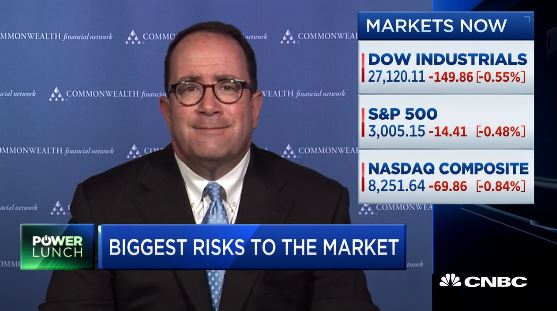
Do worries keep the economy moving? Yesterday, I appeared on Cheddar TV to discuss this and more.
July 12, 2019
Do worries keep the economy moving? Yesterday, I appeared on Cheddar TV to discuss this and more.
July 11, 2019
It’s time for our monthly look at market risk factors. Just as with the economy, there are several key factors that matter for the market in determining both the risk level and the immediacy of the risk. Although stocks remain close to all-time highs, the recent volatility is a reminder that, given valuations and recent market behavior, it is useful to keep an eye on these factors.
July 10, 2019
Although there was some good news last month—job growth bounced back to come in well above expectations—the overall trend remains negative. Confidence has continued to decline, while the yield curve hit an official inversion as of the end of June. That said, conditions remain generally favorable, with all metrics in expansionary territory except the yield curve, but there is no doubt the risk level has risen further. That risk still does not look immediate, but that point may be getting closer.
Q2 2019: it was the best of times, it was the worst of times. Okay, it wasn’t either, but last quarter we did see something that looked like both. After hitting new highs in April (the best!), markets declined significantly in May for the first time all year (the worst!) and then bounced back in June close to all-time highs. Internationally, we saw the same story, although to a lesser extent, as both developed and emerging markets echoed U.S. performance with an up-down-up pattern. We closed the quarter on a positive note, though, with all major indices up around the world. As far as the stock market is concerned, it was a good quarter.
July 8, 2019
There were a number of important economic updates released last week, as we kicked off the second half of the year. The most notable release was June's employment report, which came in much better than anticipated. This will be a relatively quiet week on the economic update front, with a focus on the Fed and inflation.
July 5, 2019
Growth has been solid this year. Consumers remain confident, and business continues to hire and invest. Indeed, markets have responded to these positive conditions, as they are once again close to new highs. If the economy continues to grow and the fundamentals remain solid, which is likely, we should continue to see more progress in the markets.
July 3, 2019
Happy Independence Day! Independence Day is actually one of my favorite science fiction B movies. It gave me one of my best laugh lines for speeches: “You remember the movie Independence Day—it started with aliens destroying Washington, DC. Later on, though, it turned out they were hostile.”
Last week saw the release of a number of important economic updates, as we wrapped up the end of the second quarter. Both major measures of consumer confidence declined month-over-month in June, but personal income and spending growth both remained healthy. This week will also see the release of a number of important economic reports, even with the federal holiday on Thursday.
July 1, 2019
June was a great month for markets around the world, capping off a strong second quarter. With so many worries about slowing growth, earnings, geopolitics, and trade, why are we seeing such strength? The Fed’s more dovish comments at the June meeting had a lot to do with pushing markets up. Plus, the economic data—from retail sales to housing—is solid. For all the worry, things are actually pretty good.
June 28, 2019
There has been a great deal of coverage on slowing growth. Indeed, on this blog we have looked at signs that the recovery may be close to the end. What that means, of course, is that a recession may well be in the cards in the next couple of years. Although we are not there yet, now is a good time to take a closer look at what it could look like. After all, it has been more than 10 years since we last had a recession, and that one was not typical.
Episode 14
December 17, 2025
Episode 13
November 19, 2025
Episode 12
October 14, 2025
Episode 11
September 10, 2025
Episode 10
August 13, 2025
The information on this website is intended for informational/educational purposes only and should not be construed as investment advice, a solicitation, or a recommendation to buy or sell any security or investment product. Please contact your financial professional for more information specific to your situation.
Certain sections of this commentary contain forward-looking statements that are based on our reasonable expectations, estimates, projections, and assumptions. Forward-looking statements are not guarantees of future performance and involve certain risks and uncertainties, which are difficult to predict. Past performance is not indicative of future results. Diversification does not assure a profit or protect against loss in declining markets.
The S&P 500 Index is a broad-based measurement of changes in stock market conditions based on the average performance of 500 widely held common stocks. All indices are unmanaged and investors cannot invest directly in an index.
The MSCI EAFE (Europe, Australia, Far East) Index is a free float‐adjusted market capitalization index that is designed to measure the equity market performance of developed markets, excluding the U.S. and Canada. The MSCI EAFE Index consists of 21 developed market country indices.
The Dow Jones Industrial Average is computed by summing the prices of the stocks of 30 large companies and then dividing that total by an adjusted value, one which has been adjusted over the years to account for the effects of stock splits on the prices of the 30 companies. Dividends are reinvested to reflect the actual performance of the underlying securities.
The Russell 2000 is a market-capitalization weighted index, with dividends reinvested, that consists of the 2,000 smallest companies within the Russell 3000 Index. It is often used to track the performance of U.S. small market capitalization stocks.
One basis point (bp) is equal to 1/100th of 1 percent, or 0.01 percent.
The VIX (CBOE Volatility Index) measures the market’s expectation of 30-day volatility across a wide range of S&P 500 options.
The forward price-to-earnings (P/E) ratio divides the current share price of the index by its estimated future earnings.
Third-party links are provided to you as a courtesy. We make no representation as to the completeness or accuracy of information provided on these websites. Information on such sites, including third-party links contained within, should not be construed as an endorsement or adoption by Commonwealth of any kind. You should consult with a financial advisor regarding your specific situation.
Member FINRA, SIPC
Please review our Terms of Use.
Commonwealth Financial Network®