Print
Print Stocks have been on a bit of a rollercoaster over the past two months. If your nature is to tune out the noise and check in occasionally, you might have missed it. After a 9 percent sell-off earlier in the year, markets quickly rebounded and have recently traded at all-time highs.
The situation in the Middle East remains fluid and, on some level, hasn’t changed much in April. Yet investor confidence about the future has returned. It seems that despite geopolitical headlines and short-term market swings, investors are refocusing on the fundamentals.
Ceasefire Extended, But Negotiations on Hold
Markets have been dominated by headlines around progress toward an end to the war in the Middle East. Last week began with the news that the negotiations over the weekend in Pakistan had not resulted in a deal and that the U.S. contingent had returned home. But by the end of the week, it was announced that Iran had opened the Strait of Hormuz, and oil prices declined accordingly. But over the weekend, the Strait was closed once again.
That is the definition of a still-fluid situation. While the ceasefire was extended indefinitely, plans for further negotiations remain on hold. It is encouraging that the two countries seem to be communicating through back channels about the parameters for restarting in-person negotiations. What is still missing is a finalized deal to end the war that both parties have agreed to.
For markets, the key concern wasn’t the daily headlines. It was whether oil prices would spike enough to slow economic growth and impact corporate earnings. Markets now appear to be pricing in a far less likely possibility for the direst outcomes, although uncertainty remains.
Beyond geopolitics, investors are also reassessing domestic policy risks.
The Fed Moving Back into the Spotlight
Kevin Warsh, the Fed chair nominee, began his confirmation process Tuesday by testifying before the Senate Banking Committee. The timing of the committee’s vote remains in limbo, as Senator Thom Tillis is withholding his vote until the Department of Justice’s criminal investigation into current Chair Jerome Powell concludes. Nonetheless, Warsh reassured investors about how he intends to lead the Fed.
The market-friendly aspects of his testimony highlighted his belief in Fed independence and his role in protecting it. He also made no promises about the next move on interest rates. Warsh certainly differs from his predecessor in terms of the size of the Fed’s balance sheet, how it measures inflation, and how it sets policy. He is also optimistic about the productivity benefit of AI.
Generally, investors came away feeling that a Chair Warsh would be a steady hand and not make dramatic changes for the sake of change. We continue to believe the Fed will be data-driven in setting policy, whether Chair Powell or Warsh is at the helm over the next few months.
But confidence in monetary policy stability alone doesn’t push markets higher. Profits do.
Earnings, Earnings, Earnings
The biggest reason that markets are near all-time highs is that earnings growth has been surprisingly strong over the last year and a half. Ultimately, stock prices follow profits. As long as earnings continue to grow, markets tend to recover from short-term fear. Despite all the headlines that have driven markets—from tariffs to Fed independence to war in the Middle East—corporate America has proven quite resilient and navigated it all.
While first-quarter 2026 earnings reports are only in their second week, growth is estimated to be over 13 percent. If this holds, it would be the sixth straight month of double-digit earnings growth. That would be impressive in any environment, but even more so in the current environment.
Perhaps most interesting and a more important driver of the market over the long term is that, despite all the uncertainty around the war, 2026 full-year earnings estimates continue to increase. Since the day before the war began, those expectations have moved up just over 3 percent. Full-year 2026 growth expectations are now at 18 percent, followed by another 16 percent in 2027. Investors certainly can’t hang their hats on estimates, but continued earnings strength will help markets weather any short-term headline disruptions.
A Resilient Market
Markets don’t always need good news to move higher. Sometimes they just need less bad news. The March decline was due to an uncertain future path with surging oil prices. While the situation is still uncertain, investors believe the worst-case scenario won’t play out. Concerns about the future of the Fed have also been minimized due to Warsh’s testimony.
That leaves the fundamental backdrop for markets—corporate earnings—as the focal point. That is what will drive markets over the longer-term period. While volatility is likely to continue, current earnings resilience and the anticipated strength going forward should be supportive of markets over the intermediate term.
While it has always been true, the past 18 months have shown that it is impossible to time markets. Getting off the roller-coaster ride at the wrong time would have impaired the ability to achieve long-term goals. At the same time, this backdrop has shone a light on diversification and a market where multiple different asset classes can contribute to returns.
Asset Class Returns
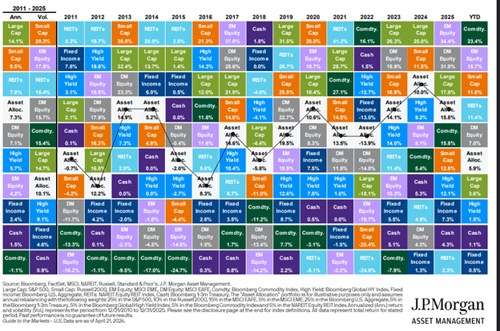
Large-cap U.S. stocks, particularly growth stocks, have certainly been the favored investment over the past 10 years. Recently, however, other areas of the market have participated and performed quite well. We anticipate this will likely continue, as earnings growth broadens across sectors, industries, companies, and geographies.
In our opinion, the best way to navigate the remainder of the year is to maintain portfolios with broad exposures to multiple asset classes.